

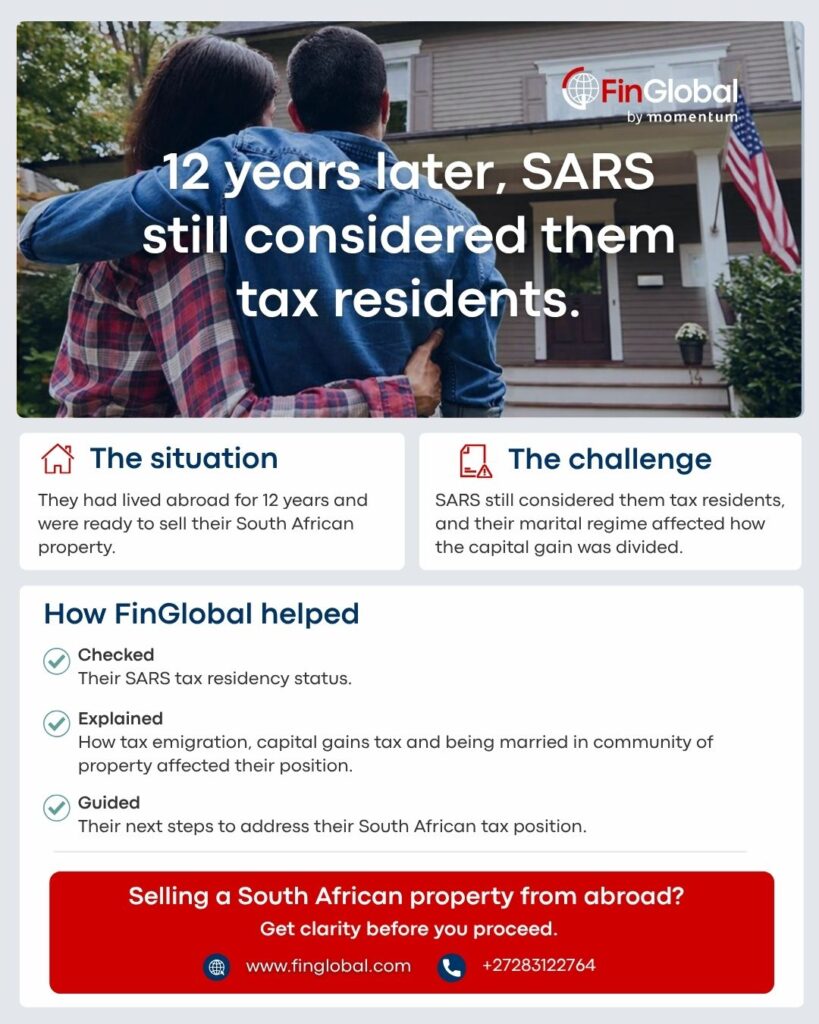
When Stanley and Emma (fictional characters based on real clients we have helped) sold a property in South Africa, things were slightly more complicated than they had anticipated. They are married in community of property and co-owned the house.
They have been living in the United States for the past twelve years. Stanley is employed there, while Emma works remotely as a freelancer. They have been renting out their South African property but decided that it was time to sell it and take the proceeds out of South Africa.
Tax on rental income in South Africa: declaring the rental income to SARS
Let’s take back a step or two. If a couple is married in community of property, the spouse who receives the rental income (usually the one in whose name the property or lease is) declares the full amount, and SARS does the 50/50 split on assessment.
Ceasing South African tax residency
Stanley and Emma approached FinGlobal to assist. We did a status check with SARS and confirmed that they were still regarded as tax residents of South Africa.
We advised them that if they did not intend to return to South Africa, SARS required them to go through the tax emigration process. This could be backdated to the date they actually left South Africa.
Deemed disposal and capital gains tax
When you cease to be a South African tax resident, you are treated as having sold your assets at market value on the day before you stop being resident, and having bought them back at that same value on the day your residency ends. It is called deemed disposal. Any capital gain up to that point is taxed in South Africa. This is generally referred to as exit tax. However, immovable property is excluded from deemed disposal.
The property falls into the joint estate, so SARS treats each spouse as having sold half, regardless of who paid what. If the capital gain or loss forms part of the joint estate, it must be split equally between the spouses.
What about the primary residence exclusion?
The primary residence exclusion is the portion of the capital gain on the sale of your home that SARS doesn’t tax. From 1 March 2026, if the property where you live as your ordinary residence and use mainly for domestic purposes is sold for up to R3 million, you are not taxed on the sale, but it must be declared to SARS. If married in community of property, both spouses must declare it on their returns.
However, the exclusion doesn’t cover gains for any period since 1 October 2001 when the owner didn’t live there. This is relevant for expats who let out a home after leaving South Africa. There are limited exceptions, such as letting the home for up to five years if you lived there for at least a year before and after your absence.
The primary residence exclusion is then apportioned between the couple.
What about capital gains tax where no immovable property is involved?
This brings another client to mind. Peter (not his real name) approached FinGlobal to cease his South African tax residency. He wanted to access his South African retirement annuity. He is married to a South African expat, and they are married in community of property.
During the initial consultation, we discovered that Peter had unit trust investments on his date of exit, which meant he had to include his spouse in the process, because for capital gains tax purposes they needed to split their assets between the two of them.
 We can help you calculate capital gains tax in South Africa
Our experts at FinGlobal have advised and helped thousands of South African expats to become tax compliant and get their money out of the country following legal guidelines and requirements. If you’ve left the country, don’t intend to return, and haven’t tax emigrated yet, reach out to us.