

South Africans looking to move funds offshore are facing a far stricter regulatory environment as the South African Revenue Service (SARS) reshapes how cross-border payments are assessed and approved.
The updated framework significantly changes how an international money transfer from South Africa is processed, shifting from a simple tax clearance approach to a far more detailed approval system.
At the centre of these changes is the Approval of International Transfer (AIT) process, which now determines whether individuals can legally transfer money from South Africa before any offshore payment can be released.
For expats and investors, this has made getting money out of South Africa more complex, with increased documentation, stricter verification, and closer coordination between SARS and banks. Let’s take a look at what’s changed.
Top 3 takeaways for South African expats on offshore transfers under AIT rules:
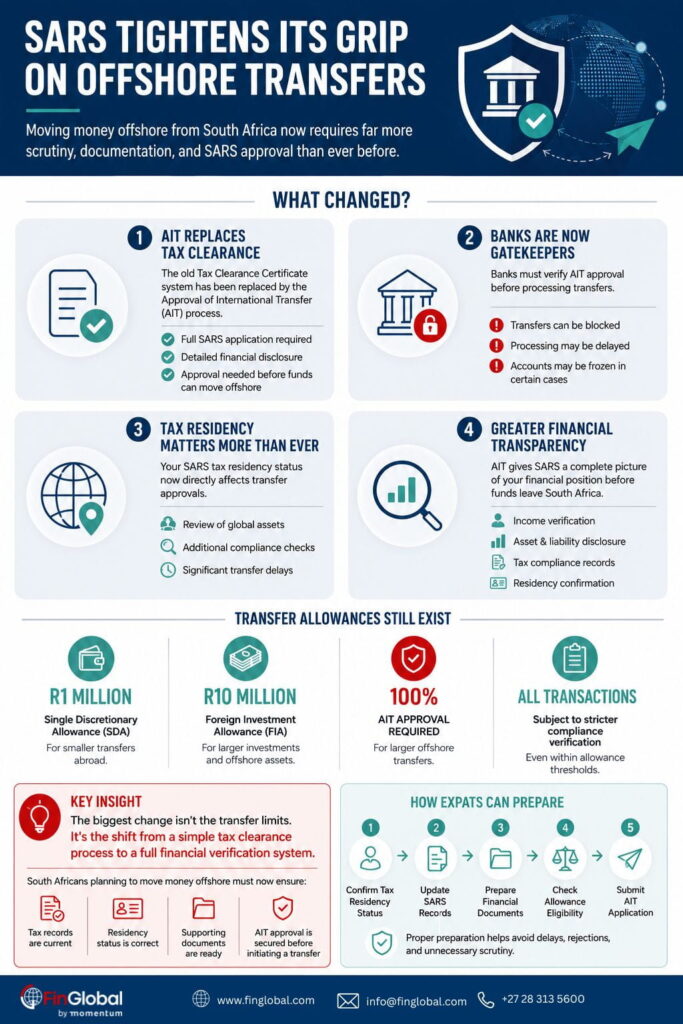
- The old tax clearance system has been replaced by the Approval of International Transfer (AIT) process. This means every international money transfer from South Africa now requires a full application and SARS approval before funds can be moved offshore, rather than a simple tax clearance certificate.
- Banks can now actively enforce compliance and can block or freeze transactions if AIT approval is missing. Any attempt to transfer money out of South Africa or complete a money transfer without approval may be stopped until SARS requirements are fully met.
- Your tax residency status is now critical to the outcome of an AIT application. Incorrect classification can trigger extensive SARS review of your global financial position when applying to get money out of South Africa or submitting an AIT application request.
Read more: How to get your money out of South Africa via SARS Approved International Transfer.
Why SARS changed the rules for transferring money out of South Africa
The shift from tax clearance certificates to the AIT process reflects a broader tightening of exchange control and compliance oversight.
Previously, individuals could rely on a tax clearance certificate to support a South African money transfer request with minimal additional scrutiny. Under the new system, SARS now requires a full Approval for International Transfer, which gives authorities broader visibility over income, assets, liabilities, and offshore interests before any transaction sending money abroad from South Africa is permitted.
This change is designed to strengthen compliance monitoring and reduce unverified capital outflows.
Read more: International money transfers from SA – what SARS wants you to know about the AIT process.
How the AIT process works for getting money out of South Africa
The AIT process is no longer just a simple administrative step. It is a full financial disclosure and verification system. Individuals must complete an AIT application with SARS, declaring detailed financial information before any request to transfer money out of South Africa can proceed.
Supporting requirements can include:
- Proof of income and tax compliance
- Asset and liability disclosures
- Residency status confirmation
- Supporting documents for Approval International Transfer.
In some cases, taxpayers may still need a TCS PIN, but this now forms part of a broader compliance verification framework rather than a standalone requirement.
SARS also uses this process to assess whether the individual qualifies under frameworks such as the Foreign Investment Allowance or the Single Discretionary Allowance in South Africa; both of which are only available to tax residents.
What are the limits for transferring money out of South Africa in 2026?
Despite stricter controls, tax resident individuals can still legally move money offshore under existing allowances, provided compliance requirements are met.
The Single Discretionary Allowance in South Africa remains available for smaller transactions, allowing individuals to transfer funds abroad without full capital control approval up to prescribed limits. For larger amounts, the Foreign Investment Allowance applies, but this now requires full AIT approval before the request to transfer money overseas from South Africa can be processed.
In practice, all outgoing transactions are now subject to tighter verification, even when within allowance thresholds. Non-resident South Africans (i.e: those who have completed tax emigration) need AIT approval for all transactions.
Read more: Six things SARS wants you to know about the limits on transferring money out of South Africa.
Can banks block or freeze a transaction to transfer money from South Africa without AIT approval?
Yes. One of the most significant changes is the active enforcement role of banks. Financial institutions are now required to verify that valid AIT approval exists before processing any request to transfer money from South Africa.
If approval is missing, banks must stop the transaction, delay processing and in some cases, freeze accounts linked to non-compliant offshore transfer attempts. This has made expats attempts to take money out of South Africa far more sensitive to documentation accuracy and timing.
Even minor discrepancies in compliance can result in delays when attempting to complete an international money transfer from South Africa.
How tax residency affects your ability to transfer money overseas from South Africa
Tax residency is now a central factor in the AIT approval process. Applicants must declare whether they are South African tax residents or non-residents when submitting such a request to SARS.
Incorrect classification can lead to:
- Full review of global assets
- Delays in getting money out of South Africa
- Reassessment of tax obligations across jurisdictions
This is particularly important for expats who have lived abroad for extended periods but have not formally updated their tax residency status.
In these cases, SARS may still treat individuals as residents until their status is formally corrected, which directly impacts any application to transfer funds from South Africa.
Read more: Important documents and requirements for transferring money before and after leaving South Africa.
How expats can prepare for the AIT approval process in South Africa
Preparation is now essential for anyone planning to move money offshore. Before initiating any request to transfer money overseas from South Africa, individuals should ensure:
- Tax residency status is correctly recorded
- Financial records are up to date
- Required documentation for the AIT process is available
- Allowance eligibility under the Foreign Investment Allowance or Single Discretionary Allowance is confirmed
- Failure to prepare properly can result in delays or rejection of an international money transfer transaction, particularly where incomplete supporting documents for Approval of International Transfer are submitted.
 FinGlobal: cross-border tax and financial specialists
For South African expats, moving money offshore has become increasingly tied to broader tax and compliance obligations. Whether transferring retirement funds, investment proceeds, inheritances, or personal savings, it is essential to ensure that SARS records, tax residency status, and supporting documentation are fully aligned.
FinGlobal assists South Africans all over the world with international money transfers, AIT applications, tax emigration, and ongoing SARS compliance, helping simplify complex cross-border financial processes.
If you need more information about our trusted, convenient global tax and financial services, leave your contact details below and we’ll be in touch to answer your questions!