

Dreaming of a career on international yachts or already working at sea as part of the global maritime workforce? As a South African seafarer or yachtie, the world truly awaits. But before you set sail, it is essential to understand your tax obligations back home.
The South African Revenue Service (SARS) taxes residents on their worldwide income, including income earned at sea. This means that even if you are working offshore for months at a time, your South African tax responsibilities do not automatically disappear.
Understanding the seafarers tax exemption South Africa framework is key to staying compliant, avoiding penalties, and making the most of available relief. The good news is that South African tax law does offer exemptions for qualifying offshore workers, particularly under Section 10(1)(o)(i)(aa) and related provisions. However, these rules are technical and depend on residency status, time spent outside South Africa, and the nature of your employment.
Top three takeaways for South African seafarers on income tax
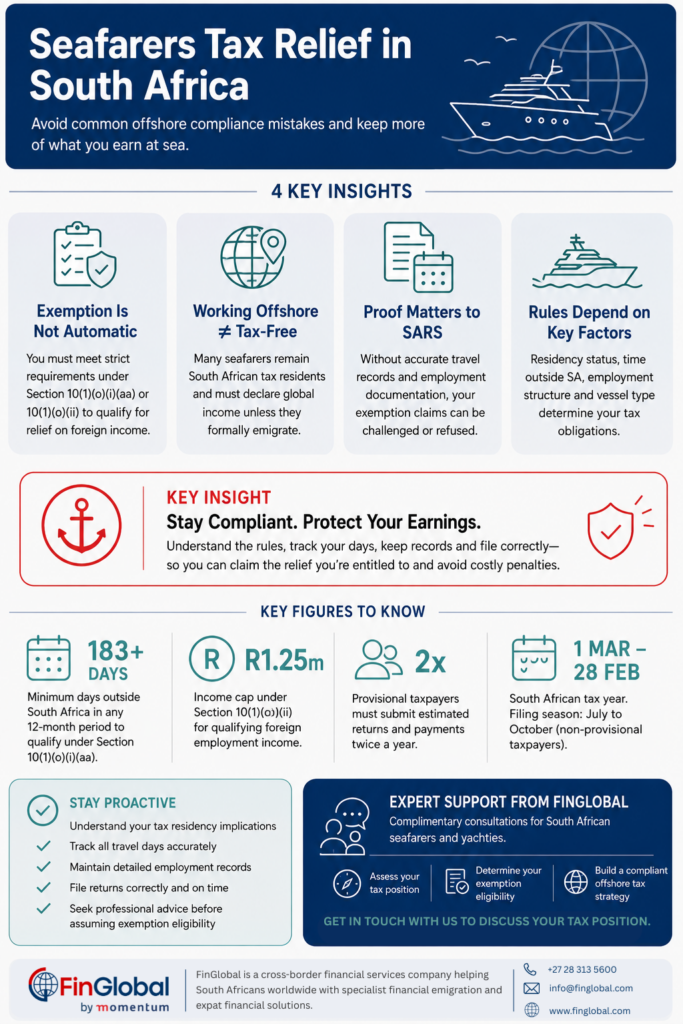
- Application of the seafarers’ tax exemption to your foreign earnings is not automatic. You must meet strict requirements under sections such as Section 10(1)(o)(i)(aa) or Section 10(1)(o)(ii) to qualify for relief on foreign employment income.
- 2Working offshore does not automatically remove your South African tax obligations. Many seafarers and South African yachties remain tax residents and must declare South African tax on foreign earnings unless they formally cease residency through tax emigration.
- SARS requires clear proof of offshore work periods. Without accurate travel records and documentation, your income tax exemption for seafarers claims can be challenged or refused, even if you qualify in principle.
Read more: Sail away – the yachtie’s guide to South African seafarers tax.
Seafarers’ tax rules: your tax residency, your anchor
South Africa operates on a residence-based tax system. This means your tax liability is determined by your residency status, not where you are located or where you physically earn your income.
SARS generally considers you a tax resident if:
- You were born and live in South Africa, or
- You are working abroad temporarily but intend to return home.
In simple terms, if you see South Africa as your long-term home, you are likely still a tax resident. This means you remain liable to declare global income, including earnings from offshore work.
Even being physically absent from South Africa does not automatically make you a non-resident. Your tax obligations remain in place until you formally cease tax residency through tax emigration.
Read more: Why South African expats must stay sharp on SARS tax residency rules.
The South African yachtie exemption lifeline: section 10(1)(o)(i)(aa)
For many offshore workers, including yacht crew, the most important relief provision is Section 10(1)(o)(i)(aa) of the Income Tax Act.
This exemption applies to officers or crew members working on ships engaged in international transport of passengers or goods. It can apply to both commercial vessels and private yachts, as long as they meet the qualifying criteria.
There is no monetary cap on the exemption, but strict conditions apply:
- The vessel must operate outside South Africa’s territorial waters (beyond 12 nautical miles)
- You must spend more than 183 days outside South Africa within a 12-month period
Importantly, this exemption is not automatic. You must prove to SARS that you meet the requirements before it will be granted.
Private yachts and tax clarity for yacht crew
A key point often misunderstood is that Section 10(1)(o)(i)(aa) applies to both commercial and private yachts. This is particularly important because a large portion of global yachts are privately owned. As long as the vessel meets the international transportation criteria, yacht crew may still qualify for the exemption.
This is an essential consideration for South African yachties, who often assume private yacht employment excludes them from tax relief. In reality, eligibility depends on structure and compliance, not ownership type.
Section 10(1)(o)(ii): the alternative exemption
While most yacht crew rely on Section 10(1)(o)(i)(aa), some seafarers may fall under Section 10(1)(o)(ii). This provision offers a capped exemption of up to R1.25 million on qualifying foreign employment income.
Key differences include:
- It applies to employees rather than independent contractors
- It is often relevant to specific offshore industries such as mining, exploration or fishing
- It focuses on income limits rather than day-count rules
In practice, Section 10(1)(o)(ii) may apply where the day-count requirements of Section 10(1)(o)(i)(aa) are not met.
What are the income tax rules for seafarers?
A common misconception is that offshore work automatically results in tax-free income. In reality, income tax rules for seafarers depend on:
- Residency status
- Employment structure
- Vessel type
- Time spent outside South Africa
This is why understanding South African tax on foreign earnings is so important. SARS requires full disclosure of global income for residents, even if exemptions apply.
Read more: How do I declare foreign income on my tax return?
Tax year, provisional taxpayers and filing obligations
The South African tax year runs from 1 March to 28 February. Filing season typically opens in July and closes in October for non-provisional taxpayers.
Many seafarers fall into the category of provisional taxpayers because they earn income from foreign employers.
Provisional taxpayers are required to:
- Submit estimated tax returns twice a year
- Declare expected taxable income
- Make advance payments to SARS
SARS determines provisional taxpayer status automatically. It is not optional, and taxpayers are notified when they qualify.
Read more: Provisional tax in South Africa: what expats need to know to avoid SARS penalties.
Seafarers tax relief: how the exemption works in practice
Example 1: Full exemption achieved
Muller signs a nine-month contract as a deckhand on a Bahamas-based yacht, earning 5,000 Euros per month.
- He spends more than 183 days outside South Africa
- He meets the requirements of Section 10(1)(o)(i)(aa)
- His full income of 45,000 Euros is exempt from South African tax
Example 2: Partial tax liability
Muller later takes a five-month contract in the Maldives earning 15,000 Euros.
- He does not meet the 183-day requirement
- The exemption does not apply
- His income becomes taxable in South Africa under normal rules
Why seafarers must stay proactive with SARS tax compliance
Managing seafarers tax rules is not just about understanding exemptions. It is about staying compliant year-round.
Seafarers should:
- Understand tax residency implications
- Track all travel days accurately
- Maintain detailed employment records
- Ensure correct tax filings
- Seek professional advice before assuming exemption eligibility
For many offshore workers, reviewing tax residency or considering tax emigration may be an important long-term step.
Read more: Tax Emigration: A Vital Step for South African Expats.
FinGlobal: tax support for South African seafarers
Understanding your tax obligations as a South African seafarer or yachtie can be complex. SARS rules are strict, technical and frequently misunderstood.
That’s why FinGlobal offers complimentary consultations for South Africans working at sea, helping you assess your tax position, determine whether you qualify for available exemptions, and build a compliant offshore tax strategy.
Whether you need assistance with applying the seafarers tax exemption in South Africa, you have questions about foreign income compliance or cross-border tax planning, professional guidance from FinGlobal can ensure smoother sailing both at sea and with SARS.
Ready to learn more about how FinGlobal can streamline your offshore tax affairs while you’re earning money at sea? Leave your contact details below, and we’ll be in touch.