



For many South Africans moving overseas, deciding what to do with the family home is one of the biggest financial decisions in the emigration process. Some people sell property in South Africa before they leave. Others keep their property for a few years and sell later once they are settled abroad.
What many South Africans don’t realise is that the timing of the sale can have a major impact on tax.
If you are in the process of ceasing South African tax residency, the difference between selling before or after becoming a non-resident could affect your capital gains tax liability on the property in South Africa, as well as your access to the South African capital gains tax primary residence exclusion, and even how easily you move your money offshore.
That is why property sales and tax residency should always be considered together, especially if you are planning a permanent move abroad.
Top three takeaways for future expats on selling property in South Africa
- Selling your home before ceasing tax residency could help you make better use of the SARS primary residence exclusion to reduce your capital gains tax exposure in South Africa.
- If you sell your property in South Africa after becoming a non-resident, additional SARS processes and withholding tax rules may apply.
- The earlier you plan your emigration strategy for your finances, the more options you may have to structure things tax-efficiently.
Read more: Planning to move abroad? Here’s how to safeguard your assets.
How does capital gains tax work when selling property in South Africa?
When you sell property in South Africa for more than you originally paid for it, the profit may be subject to capital gains tax. The gain is calculated by taking the selling price and subtracting the original purchase price, along with certain qualifying costs such as:
- Transfer fees
- Legal costs
- Estate agent commission
- Approved improvements made to the property
This is why keeping records and paperwork matters when selling a house in South Africa, especially if you have owned the property for many years. The taxable portion of the gain is then included in your taxable income and taxed at your marginal tax rate.
Read more: Expat essentials – Understanding Capital Gains Tax in South Africa.
The primary residence exclusion can make a big difference.
One of the biggest tax breaks available to homeowners is the South African CGT primary residence exclusion. If the property you are selling is your main home, a portion of the capital gain can be excluded from tax. This is commonly referred to as the SARS primary residence exclusion.
From 1 March 2026, the exclusion increased from R2 million to R3 million, which is good news for homeowners who have seen strong property growth over time. For many emigrating South Africans, this capital gains tax on the primary residence in South Africa exclusion can make a substantial difference to the final tax bill.
But there is an important catch: timing matters.
Your tax residency status, how long you lived in the property, and whether the home was used purely as a residence all play a role in how the exemption applies.
Read more: Capital Gains Tax – what is exempt from CGT in SA? Resident vs non-resident?
Scenario A: Selling property in South Africa before ceasing tax residency
For many expats, this is often the cleaner and simpler option. Selling your property before formally ceasing South African tax residency may help you maximise the South African capital gains tax primary residence exclusion while your tax affairs are still fully local.
You may get the full benefit of the primary residence exclusion.
If the property qualifies as your primary residence at the time of sale, you are generally in a stronger position to benefit from the available exclusion. Depending on the size of the gain, this could significantly reduce the tax on the sale of property in South Africa.
It can simplify your tax emigration process.
Many South Africans prefer to finalise major financial matters before leaving the country permanently. Selling a property in South Africa upfront may make it easier to:
- Settle local tax matters
- Transfer funds abroad
- Avoid ongoing South African property administration from overseas
For people trying to create a clean financial break from South Africa, this route can offer more certainty.
Scenario B: South African capital gains tax on property sale for non-residents
Of course, not everyone wants to sell immediately. Some expats choose to keep property in South Africa as an investment, rent it out for additional income, or hold onto it in case they decide to return one day.
That is perfectly acceptable, but there are additional tax considerations once you become a non-resident.
SARS can still tax the property sale
Even after ceasing tax residency, South Africa still has taxing rights over immovable property located in the country. So, if you later sell property in South Africa while living abroad, capital gains tax on property in South Africa may still apply.
Read more: Selling your property in South Africa – the guide to expat Capital Gains Tax implications.
South African withholding tax on the sale of immovable property by a non-resident
This is one area that often catches expats off guard. When a non-resident is selling a house in South Africa above certain price points, the buyer may be required to withhold a portion of the purchase price and pay it directly to SARS.
This is a withholding tax on the sale of immovable property by a non-resident. The withholding amount is not always the final tax owed, but it does create an additional compliance step that resident sellers generally do not face.
There can be more admin involved when selling property in South Africa from abroad
Selling property from abroad can also involve:
- SARS tax clearance processes
- Additional supporting documents
- Delays in transferring funds offshore
- Communication challenges with local service providers
None of these issues is unmanageable, but they do add complexity.
Hidden costs when selling a house in South Africa
Capital gains tax on property in South Africa is only one part of the picture. There are also several hidden costs when selling a house in South Africa, including:
- Estate agent commission
- Bond cancellation fees
- Compliance certificates
- Conveyancing costs
- Municipal charges
If you are emigrating, these costs should form part of your broader financial planning. It is also important to make sure you have all the documents required to sell a house in South Africa, particularly if the transaction will be managed remotely after you move abroad.
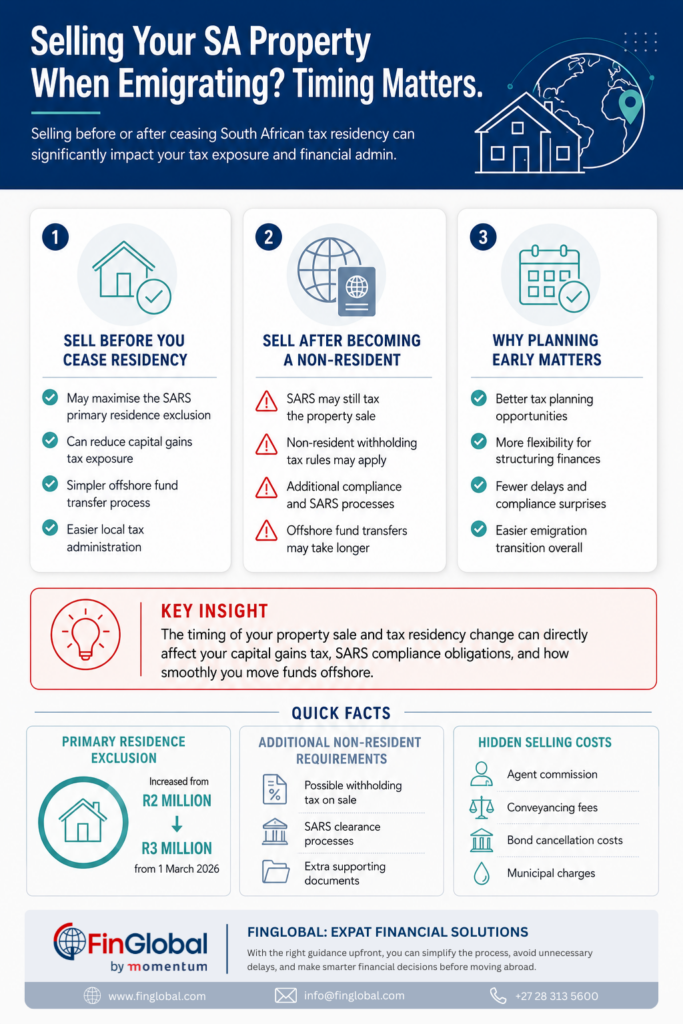

When you sell property in South Africa as part of your emigration journey, timing matters. Selling before or after ceasing South African tax residency can affect your capital gains tax exposure, trigger additional SARS compliance requirements, and influence how easily you can move your money offshore.
FinGlobal helps South Africans worldwide through every step of the process, from tax emigration and SARS tax clearance to the legal repatriation of funds after a property sale. With the right guidance upfront, you can simplify the process, avoid unnecessary delays, and make smarter financial decisions before moving abroad.
Want to hear more about FinGlobal’s trusted cross-border services? Leave your contact details below, and we’ll be in touch to discuss your specific requirements.
Send us a message
Leave your details below including a short message and a financial consultant will contact you.
Licensed South African Financial Services Provider FSP # 42872
You have Successfully Subscribed!
FinGlobal Newsletter Subscription
Subscribe to the FinGlobal newsletter to receive all the latest news and information regarding our services and South African Expats.