



For South Africans living overseas, inheriting assets from abroad can feel straightforward at first — until you try to move the money, transfer ownership, or stay compliant with South African regulations. Whether you’ve completed tax emigration from South Africa or still qualify as a tax resident, understanding what regulators look for is critical.
When it comes to cross-border inheritance, both SARS (South African Revenue Service) and SARB (South African Reserve Bank) play a role. Each has a different focus — but both are essential in determining how and when you can transfer money out of South Africa or receive funds from abroad.
Top 3 takeaways for South African expats on inheritances
- There’s no direct inheritance tax — but compliance still matters. While there’s no formal inheritance tax in South Africa, estate duty is applied to the deceased estate. As a beneficiary, you may not pay tax on receipt, but SARS will still assess your tax residency status, ongoing tax obligations, and whether any future income or disposals (like property sales) trigger tax.
- SARS and SARB approvals are key to moving your money. To transfer money out of South Africa or receive funds from abroad, you’ll need to meet both tax and exchange control requirements. This often includes SARS tax clearance via the AIT Process (Approval For International Transfers), along with full supporting documentation to prove the source of funds.
- Your transfer limits and structuring matter more than you think. If you’re externalising a local inheritance, your transfers may fall within the Single Discretionary Allowance and Foreign Investment Allowance, which determine how much money you can transfer from South Africa each year. Proper structuring of your cross-border inheritance can help avoid delays, reduce compliance risk, and improve access to your funds.
Read more: Claiming your South African inheritance from abroad.
Understanding inheritance tax and estate duty in South Africa
One of the most common questions is: Do you pay tax on inheritance money in South Africa?
The short answer: there is no direct inheritance tax in South Africa. Instead, South Africa applies estate duty on the deceased’s estate.
This means:
- The estate pays tax before assets are distributed
- Beneficiaries typically receive inheritances tax-free
- The current estate duty rate is 20% (and 25% above certain thresholds)
However, this doesn’t mean there are no tax implications. If you inherit assets such as property, shares, or offshore investments, other taxes may apply:
- Capital Gains Tax on inherited property in SA (on disposal, not receipt)
- Ongoing income tax (e.g., rental income from property)
- Potential foreign tax obligations depending on jurisdiction
For SARS purposes, your tax residency status will determine whether your worldwide income is taxable in South Africa.
Read more: Inheriting a house in South Africa from abroad: what are the steps to follow?
What SARS looks at: compliance and source of funds
When dealing with a South African inheritance overseas or receiving inheritance money from overseas, SARS is primarily concerned with compliance.
Here’s what they assess:
1. Tax residency status: Your status — whether you’ve completed tax emigration or not — affects how SARS treats the inheritance.
- Residents are taxed on worldwide income
- Non-residents are only taxed on South African-sourced income
Read more: Do you need tax emigration to receive your South African inheritance?
2. Nature of the inheritance: SARS will verify whether the funds are legitimately an inheritance and not disguised income or donations. This is especially important in inheritance claims, where supporting documentation is required.
3. Supporting documentation: You’ll typically need:
- A copy of the will
- Letter of executorship from the Master of the High Court, deceased estates
- Estate accounts and distribution statements
- Proof of payment
Without proper documentation, delays are common — and in some cases, transactions can be blocked.
Read more: Document checklist for transferring an inheritance from South Africa.
4. Tax compliance status: Before funds can move, SARS will check whether your tax affairs are in order.
This includes:
- Up-to-date tax returns
- No outstanding tax debt
- Full disclosure of offshore assets (where applicable)
If you’re planning an international money transfer from South Africa, you’ll likely need SARS tax clearance through the AIT Process (Approval For International Transfers).
Read more: How to get your inheritance money out of South Africa.
What SARB looks at: exchange control compliance
While SARS focuses on tax, SARB oversees exchange control rules — especially when you want to transfer funds abroad from South Africa.
For SARB inheritance cases, the key question is: Does the transfer qualify for exchange control approval?
1. Source of funds verification: SARB will require proof that the funds originate from a legitimate inheritance. This overlaps with SARS requirements, reinforcing the need for complete documentation.
2. Flow of funds: Whether you’re trying to:
- Transfer money from South Africa to an offshore account; or
- Bring inheritance proceeds into South Africa
SARB tracks the movement to ensure it complies with exchange control regulations.
3. Use of allowances: If the inheritance is local and you want to externalise it, your transfer may fall within:
- The Single Discretionary Allowance (currently R2 million per year)
- The Foreign Investment Allowance (up to R10 million per year, subject to tax clearance)
Available to tax residents only, these allowances are exchange control limits that determine how much money you can transfer from South Africa annually.
4. Special exemptions: In some cases, foreign inheritances may be exempt from exchange control approval — particularly where:
- The deceased was a non-resident
- The assets are already offshore
This is why structuring matters when it comes to cross-border inheritance tax planning.
Special inheritance scenarios: property and offshore assets
1. Inheriting a house in South Africa: If you’re inheriting a house in South Africa as a non-resident:
- You can retain, sell, or transfer the property
- Proceeds from a sale can usually be repatriated, subject to SARB approval
- CGT may apply on disposal
2. Receiving offshore inheritance: If you’re receiving inheritance money from overseas:
- No exchange control approval is generally required to keep funds offshore
- However, SARS may still require disclosure depending on your residency status
Common delays with inheritance claims in South Africa
A frequent frustration is timing. Many people ask: how long does it take to get inheritance money in South Africa?
Delays in finalisation through the Master of the High Court dealing with deceased estates are often caused by:
- Missing documentation
- SARS tax compliance issues
- Exchange control approvals
Cross-border estates can take significantly longer due to multiple jurisdictions.
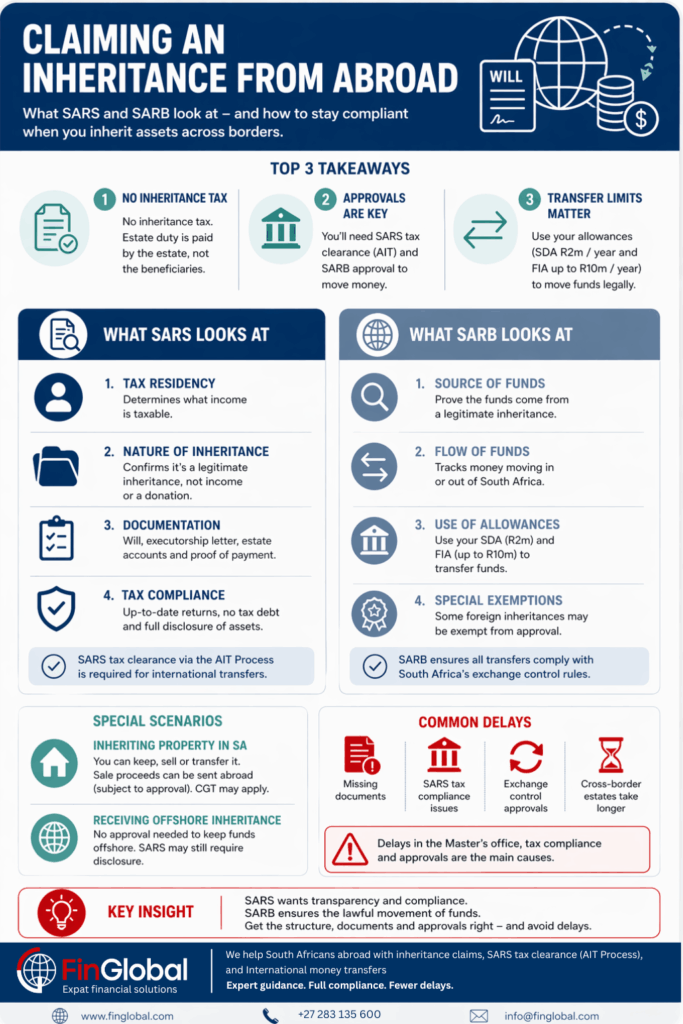

Handling a South African inheritance from overseas isn’t just about receiving money — it’s about making sure you’re on the right side of tax, compliance, and exchange control rules. SARS wants transparency and tax compliance. SARB wants to ensure the lawful movement of funds. If either requirement isn’t met, your ability to transfer money out of South Africa or access your inheritance can be delayed or denied.
For South Africans abroad — whether you’ve completed tax emigration or are still formalising your status — the key is getting the structure, documentation, and approvals right from the start. If you need help with inheritance claims, the SARS tax clearance process, or international money transfers from South Africa, FinGlobal can guide you every step of the way — ensuring your cross-border inheritance is handled efficiently, compliantly, and without unnecessary delays.
To find out more about our trusted cross-border financial services for South Africans, leave your contact details in the form below, and we’ll be in touch!
Send us a message
Leave your details below including a short message and a financial consultant will contact you.
Licensed South African Financial Services Provider FSP # 42872
You have Successfully Subscribed!
FinGlobal Newsletter Subscription
Subscribe to the FinGlobal newsletter to receive all the latest news and information regarding our services and South African Expats.