



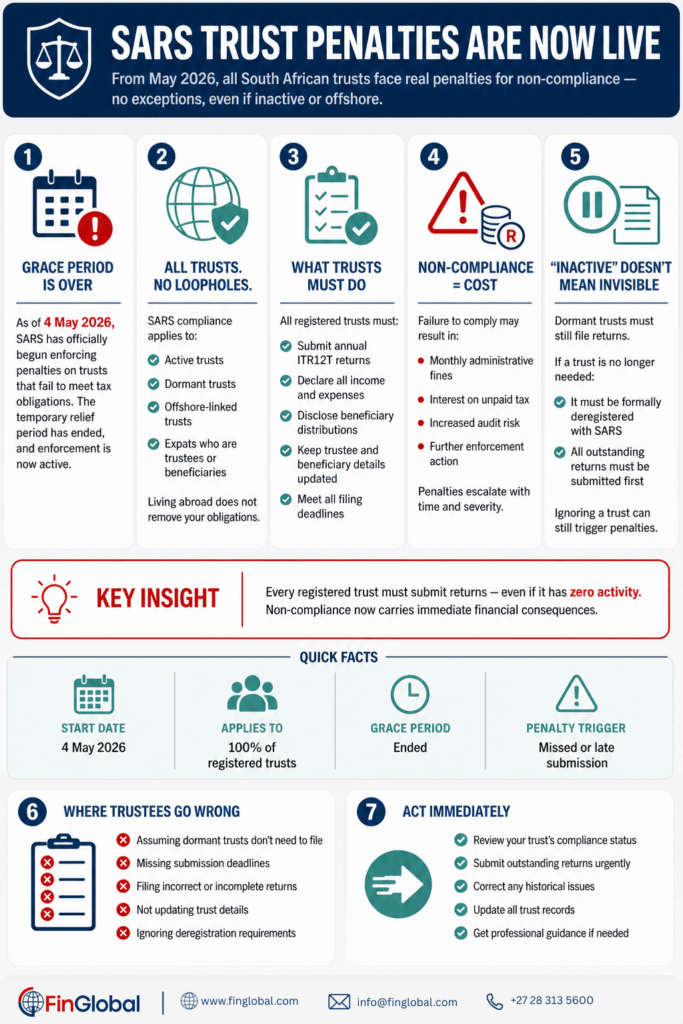
The compliance grace period is officially over. From 4 May 2026, the South African Revenue Service (SARS) has started enforcing administrative penalties for trust tax non-compliance, ending months of leniency that gave trustees time to get their affairs in order.
For many, especially South Africans living abroad, this shift may come as an unwelcome surprise. Trusts are often used as part of offshore planning structures, but SARS trust tax compliance obligations don’t fall away simply because you’ve left the country. If anything, trust tax non-compliance in South Africa is now more likely to be flagged, scrutinised, and penalised.
Top 3 takeaways for expats on tax non-compliance for trusts
- Living abroad does not exempt you from SARS trust obligations. If you are a trustee or beneficiary of a South African trust, SARS trust compliance requirements still apply. Whether you are a tax resident abroad or undergoing tax emigration, the trust itself must continue submitting trust tax returns to SARS, including the annual ITR12T return.
- Penalties apply even to dormant or inactive trusts. One of the biggest misconceptions is that inactive trusts don’t need to file. SARS has made it clear that all registered trusts must comply. Failure to submit returns will now trigger SARS administrative penalties for trusts, regardless of whether the trust generated income.
- Deregistration is not automatic, and non-compliance can delay it. If a trust is no longer needed, it must be formally deregistered with SARS. However, this can only happen once all outstanding trust tax obligations in South Africa have been met. Any delays or omissions could result in SARS penalties for trusts, even if the trust is effectively no longer in use.
Why SARS delayed penalties – and why enforcement starts now
Initially, SARS planned to introduce penalties earlier. However, following industry consultation, stakeholders raised concerns about the complexity of trust tax compliance in South Africa and requested more time to get their affairs in order.
In response, SARS granted a two-month extension. This meant that no SARS trust penalties were imposed before 4 May 2026, giving trustees a final opportunity to:
- Submit outstanding trust tax returns to SARS
- Update trust details
- Resolve compliance gaps
That grace period has now ended. From May 2026 onward, SARS penalties for trusts will apply to those who fail to meet their obligations.
What are SARS trust compliance requirements?
All trusts registered in South Africa are required to meet strict SARS trust compliance requirements, regardless of whether they are active or dormant.
This includes:
- Submitting an annual ITR12T return to SARS
- Accurately declaring all income and expenses
- Disclosing distributions to beneficiaries
- Maintaining up-to-date trustee and beneficiary information
- Meeting trust tax filing deadlines in South Africa
A common misconception is that dormant trusts are exempt. This is not the case. Even if a trust has had no financial activity, it must still comply with trust reporting requirements as determined by SARS.
What penalties will SARS impose on non-compliant trusts?
From May 2026, SARS will begin issuing SARS administrative penalties for trusts that fail to submit their tax returns.
These penalties may include:
- Monthly administrative fines for late or non-submission
- Interest on outstanding tax liabilities
- Increased likelihood of a SARS trust audit
- Additional enforcement action in cases of prolonged non-compliance
The exact penalty will depend on the severity and duration of the non-compliance, but the key takeaway is clear: trust tax non-compliance in South Africa now carries real financial consequences.
Do all trusts need to submit tax returns in South Africa?
Yes. One of the most frequently asked questions is whether all trusts must file tax returns.
The answer is really straightforward: All registered trusts must submit an ITR12T return, even if they are inactive.
Failure to do so will now trigger SARS trust penalties in South Africa, regardless of whether the trust generated income.
What if a trust is dormant or inactive?
Dormant trusts are often overlooked when it comes to SARS trust tax compliance, but they are not exempt from reporting obligations.
SARS has emphasised that:
- Dormant trusts must still submit trust tax returns to SARS
- Non-submission will result in administrative penalties for trusts
- Trustees remain responsible for compliance at all times
If a trust is no longer required, simply ignoring it is not an option.
What happens if a trust needs to be deregistered?
SARS has made it clear that you cannot simply walk away from a trust, even if it is no longer active. If a trust has already been deregistered with its regulatory authority or no longer qualifies to remain registered, it must still be formally deregistered with SARS.
Before SARS will allow this, however, the trust must first come fully up to date. This means submitting all outstanding trust tax returns to SARS and settling any unpaid tax. Only once everything is in order can a request be made to deregister the trust for income tax.
This step is often overlooked, but it is important. If a trust is not properly deregistered, it can still face SARS penalties for trusts, even if it is no longer being used.
Why SARS is cracking down on trusts now
The increased enforcement of SARS trust penalties forms part of a broader effort to improve tax compliance and transparency. Trusts have historically been used for estate planning and asset protection, but they have also been subject to misuse in some cases.
In strengthening trust reporting requirements, the revenue authority aims to:
- Improve visibility over trust structures
- Ensure accurate tax collection
- Reduce tax avoidance risks
For trustees, this means greater accountability and stricter oversight, along with a higher risk of errors carrying consequences.
Common trust tax compliance mistakes to be aware of
Many trustees fall into avoidable traps when it comes to trust tax compliance in South Africa. Some of the most common mistakes include:
- Assuming dormant trusts do not need to file
- Missing trust tax filing deadlines in South Africa
- Submitting incomplete or incorrect ITR12T returns
- Failing to update trustee or beneficiary details
- Not registering the trust correctly with SARS
With SARS trust penalties now in effect, these errors can become costly.
What should trustees do now?
With SARS administrative penalties for trusts now in force, trustees are no longer operating within a grace period. The focus has shifted to managing the consequences of non-compliance and preventing further penalties.
Acting sooner rather than later is critical. Trustees should:
- Review their current SARS trust compliance status
- Submit any outstanding trust tax returns to SARS without delay
- Ensure all trust information is accurate and current
- Address any historical non-compliance issues
- Seek expert guidance where required
The window for voluntary compliance has closed, and SARS administrative penalties for trusts are now a reality. Trustees should act immediately.

Need help getting your trust tax affairs in order? With SARS trust penalties now in effect, addressing outstanding compliance is more urgent than ever — especially for South Africans living abroad with complex financial structures.
FinGlobal can assist with regularising your SARS tax affairs, identifying compliance gaps, and helping you make sense of the requirements linked to trust tax compliance in South Africa. Whether your trust forms part of a broader tax emigration strategy or you’re unsure where you stand with SARS trust compliance after your relocation, getting the right guidance now can help you avoid unnecessary penalties and delays.
To find out more about FinGlobal’s trusted cross-border compliance services for South African expats, leave your contact details below, and we’ll be in touch to discuss your requirements.
Send us a message
Leave your details below including a short message and a financial consultant will contact you.
Licensed South African Financial Services Provider FSP # 42872
You have Successfully Subscribed!
FinGlobal Newsletter Subscription
Subscribe to the FinGlobal newsletter to receive all the latest news and information regarding our services and South African Expats.