



If you’re a non-resident property owner earning rental income in South Africa, you may have experienced a frustrating surprise. Your bank freezes or delays access to your rental income and asks for a SARS AIT PIN before releasing the funds. For many, this feels like a sudden compliance hurdle with little explanation. But this requirement is not arbitrary. It sits at the intersection of tax compliance requirements, exchange control rules, and increased scrutiny around international money transfer from South Africa.
Here’s what’s really going on and what you need to do about it.
Top 3 takeaways for non-residents on rental income taxation in SA
- A SARS AIT PIN is now a gatekeeper for accessing and transferring funds. Even if you are not planning to transfer the money out of South Africa immediately, banks may require a Tax Compliance Status (TCS) PIN before releasing rental income.
- Rental income triggers South African tax obligations for non-residents. You must declare and pay tax on rental income in South Africa, regardless of your South African tax residency status.
- Your ability to send money overseas from South Africa depends on SARS compliance. Without meeting tax compliance requirements and completing an AIT application, SARS delays in any international money transfer from South Africa are almost inevitable.
Read more: Tax tips for non-resident landlords with property in South Africa.
What is a SARS AIT PIN used for?
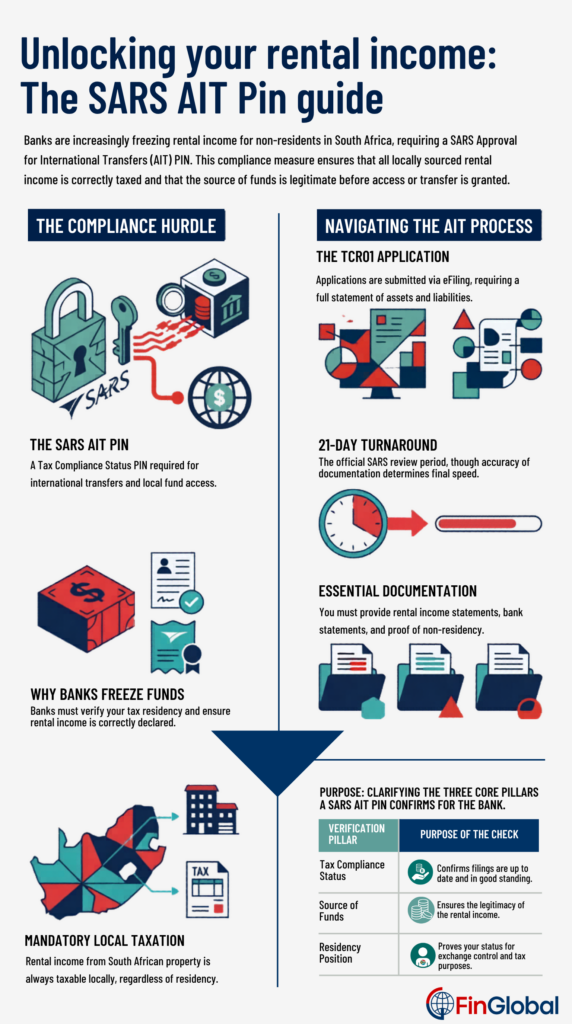
A SARS AIT PIN is issued by the South African Revenue Service (SARS) as part of the tax clearance process before an international transfer can be authorised.
AIT stands for Approval for International Transfers, and the PIN issued by SARS confirms that:
- Your tax compliance status is in good standing
- Your South African income tax return filings are up to date
- SARS is satisfied with the legitimacy of the source of your funds
Read more: International money transfers from SA – what SARS wants you to know about the AIT process.
Why do banks request a SARS AIT PIN before you transfer funds from South Africa
Banks and authorised dealers are under pressure to enforce stricter rules around South African money transfers and to keep a closer eye on cross-border flows.
For non-residents, this becomes more complex because:
- You typically do not qualify for the Single Discretionary Allowance, in terms of which tax residents can move up to R2 million without tax clearance.
- SARS now requires proof of your non-resident status for tax purposes.
- Rental income from South African property is always taxable locally by SARS.
As a result, banks often require a Tax Compliance Status PIN before allowing you to transfer funds from South Africa or even access those funds locally.
Read more: How to get your money out of South Africa via SARS Approved International Transfer.
Getting money out of South Africa: why the AIT process applies even if you don’t send money overseas.
One of the biggest frustrations for non-residents is being asked for a SARS AIT PIN even when you are not trying to immediately send the money overseas from South Africa. In reality, there are several valid reasons why you may not immediately transfer money overseas from South Africa.
You might choose to keep funds in the country because:
- You are building up rental income before making a larger transfer
- You plan to reinvest in another local property or cover expenses in SA
- You want to wait for a more favourable exchange rate before making the transfer
- You are using the funds for ongoing costs such as maintenance, levies, or bond repayments
- You prefer to keep liquidity in a local account for flexibility.
Despite this, banks do not assess your intention. Instead, they assess the nature of the funds. Once money is classified as belonging to a non-resident, it is treated as potentially transferable at any time. This triggers compliance checks typically associated with exchange control rules that relate to transferring money out of South Africa.
That is why banks rely on the Tax Compliance Status verification security PIN to confirm:
- Your South African tax residency position
- That you’ve correctly declared tax on rental income in South Africa
- That your funds meet all tax compliance requirements
In other words, this is not just about making an international money transfer from South Africa. It is about proving that your financial affairs are fully compliant before any access to funds is granted.
Tax on rental income in South Africa: what non-residents and expats must know
If you earn rental income from property in South Africa, it is always taxable locally, regardless of where you live.
This means:
- You must submit an income tax return in South Africa every year
- You must declare rental income and expenses
These obligations fall under the broader South African expat tax rules. Even if you are a non-tax resident in South Africa, SARS still taxes locally sourced income like rent.
Read more: Hot question: Do you pay tax in South Africa if you live abroad?
The SARS AIT application process explained: documents required and turnaround time.
To obtain your AIT PIN, you need to make an AIT application to SARS through eFiling. This process typically includes:
- Submitting the TCR01 form
- Providing supporting documents such as:
-Rental income statements
-Bank statements
-A full statement of assets and liabilities
Once submitted, the South African Revenue Service reviews your tax compliance status. The official SARS AIT turnaround time is 21 business days, but in reality, it depends on how complete and accurate your submission is. If everything is in order, approval can be relatively quick. If not, delays are common.
Read more: Don’t let SARS delay your international transfer – essential documents for expats.
How often do you need to apply for an AIT PIN from SARS?
A common misunderstanding is that an AIT PIN is permanent. In reality:
- It is often linked to a specific South African transfer or amount
- You will need to reapply for each international money transfer out of South Africa if you are a non-resident
- Ongoing compliance is required to maintain a valid tax compliance status.
This forms part of the broader TCS international transfer system used to regulate cross-border flows.
Transferring money out of South Africa: common mistakes non-residents make.
Many non-residents run into delays because of incorrect assumptions. Some common pitfalls include:
- Assuming you are a non-tax resident of South Africa without having already formally ceased tax residency
- Failing to declare rental income under tax for South African expats
- Believing AIT only applies when actively transferring money out of South Africa limits
In reality, SARS focuses on substance over assumption. Your actual compliance matters more than your perceived tax resident status.
Read more: South African tax residency rules – expats, are you still tax residents of South Africa?

If your bank has asked for a SARS AIT PIN, it is a clear signal that compliance comes first. Before attempting to send money overseas from South Africa, make sure you:
- Check your tax compliance status on eFiling
- Submit all outstanding income tax return South Africa filings
- Prepare for your AIT application with the correct documents
- Get expert advice if your situation involves non-resident tax complexities
The bottom line is simple. Whether you are earning rental income or planning an international money transfer from South Africa, your ability to move funds depends on being fully tax-compliant.
This is where FinGlobal can assist. Whether you need guidance clarifying your tax resident status, completing tax emigration, obtaining proof of your non-resident tax status, gaining SARS tax clearance, or making an international money transfer from South Africa, FinGlobal’s team of cross-border tax and exchange control specialists is ready to make it happen for you.
To find out how FinGlobal can save you time, stress, and unnecessary delays on international transfers, leave your contact details below, and we’ll be in touch to discuss your requirements.
Send us a message
Leave your details below including a short message and a financial consultant will contact you.
Licensed South African Financial Services Provider FSP # 42872
You have Successfully Subscribed!
FinGlobal Newsletter Subscription
Subscribe to the FinGlobal newsletter to receive all the latest news and information regarding our services and South African Expats.